
What Are AI Phone Call Agents?
An AI phone call agent is an automated software program powered by artificial intelligence that can handle inbound and outbound phone calls. It uses natural language processing to understand human speech, hold realistic conversations, and perform specific tasks like booking appointments, answering common questions, qualifying leads, or routing calls without human intervention.
You’re at lunch, and your business phone rings. You can’t answer. In the past, that meant a missed opportunity. In fact, 85% of callers who don’t get an answer will not call back. That’s a potential customer, a valuable lead, or a critical support query, gone forever. For a small business owner, every call counts. This is the exact problem AI phone call agents are designed to solve.
Beyond the Answering Machine: The Evolution of Voice AI
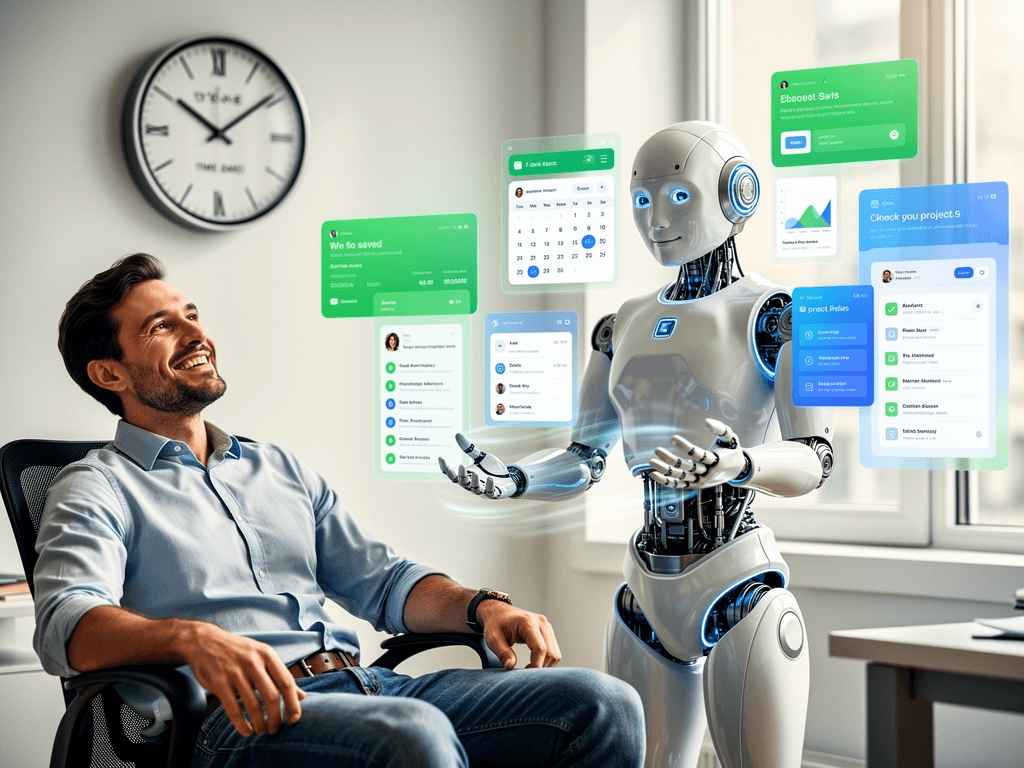
Think beyond the robotic, frustrating phone trees of the past. Modern AI voice agents are a world away from simple interactive voice response (IVR) systems. Thanks to massive advancements in conversational AI, these tools can understand context, detect sentiment, and respond dynamically. It’s less ‘press one for sales’ and more like having a highly efficient, endlessly patient receptionist who works 24/7.
How AI Voice Agents Differ from IVR Systems
Traditional IVR systems are rigid, rule-based trees. They force callers down a predefined path with a limited set of keypad options. AI voice agents, by contrast, are conversational. They allow the caller to speak naturally, interpreting their intent and providing a relevant, intelligent response. The difference is between a rigid flowchart and a fluid conversation.
Why Should Your Small Business Use an AI Phone Agent?
Your small business should use an AI phone agent to ensure no lead is ever missed, dramatically reduce operational costs, and free up your team for high-value strategic work. It provides an instant, professional response to every caller, 24/7, improving customer satisfaction and capturing revenue that would otherwise be lost.
The value proposition is simple: do more with less. Small business owners are famously short on time, with some spending around 40% of their working hours on non-billable administrative tasks. An AI phone agent directly attacks this problem, acting as a force multiplier for your business. It’s not about replacing people; it’s about augmenting them. For a deeper dive into this concept, see our guide on AI workflow automation for small businesses.
Capture Every Lead, 24/7
Leads are perishable. Research from Harvard Business Review shows that firms contacting potential customers within an hour are nearly 7 times more likely to qualify the lead. An AI agent responds instantly, qualifies the lead based on your criteria, and can even book a follow-up call with a human sales rep directly into their calendar.
Reduce Operational Costs
Hiring a full-time receptionist can be a significant expense. An AI phone agent can handle a high volume of calls for a fraction of the cost. According to McKinsey, AI can help reduce customer service costs by up to 40% by automating routine inquiries and tasks. This allows you to reinvest that capital back into growth.
Improve Customer Experience with Instant Responses
In an on-demand world, waiting is a business killer. Over 60% of consumers report switching to a competitor after just one poor customer service experience. An AI agent provides immediate, consistent, and polite service every time, answering questions about hours, location, or services without making the customer wait.
Free Up Your Team for High-Value Work
How much time does your team spend answering the same five questions every day? An AI agent handles these repetitive, low-value interactions, freeing up your skilled human employees to focus on complex problem-solving, building customer relationships, and closing deals. This boosts both productivity and morale. It’s one of the most effective AI tools that actually save small business owners time.
What Key Features Should You Look for in an AI Call Agent?
When choosing an AI call agent, you should look for key features like advanced natural language processing for human-like conversation, seamless integration with your calendar and CRM systems, and customizable scripting to match your brand’s voice. Also, prioritize tools that offer intelligent call routing, detailed analytics, and robust transcription capabilities.
Not all AI phone agents are created equal. The right feature set can mean the difference between a clunky answering machine and a powerful business automation tool. As you evaluate options, focus on how each feature solves a specific business problem.
Natural Language Processing (NLP) and Conversational Ability
This is the core technology. The AI must be able to understand slang, accents, and complex sentences. The goal is a smooth, natural conversation, not a frustrating robotic exchange. Modern systems can achieve near-human levels of naturalness, so don’t settle for less.
Calendar Integration for Seamless Booking
A must-have feature. The AI should be able to check real-time availability on your Google Calendar, Microsoft Outlook, or Calendly and book appointments directly. This eliminates the back-and-forth of scheduling and is a massive time-saver.
CRM Integration for Lead Management
When the AI qualifies a lead, where does that information go? Direct integration with your Customer Relationship Management (CRM) software (like HubSpot, Salesforce, or Zoho) is critical. The AI should automatically create a new contact, log the call details, and even trigger follow-up tasks for your sales team.
Call Routing and Intelligent Triage
The agent should be smart enough to know when it’s out of its depth. It needs to be able to identify complex or urgent issues (e.g., an angry customer, a high-value sales inquiry) and seamlessly transfer the call to the appropriate human team member.
Custom Scripting and Brand Voice Personalization
Your AI agent is an extension of your brand. You need control over its script, tone, and personality. Can you make it sound formal and professional? Or warm and friendly? The ability to customize its responses ensures a consistent brand experience for your customers. According to Salesforce, 84% of customers say the experience a company provides is as important as its products.
Call Transcription and Analytics
After the call, you need data. The tool should provide full, accurate transcriptions of every conversation. It should also offer analytics on call volume, duration, common questions, and task outcomes. This data is invaluable for refining your scripts and understanding your customers better.
Which AI Phone Call Agent Tools Are Best for Small Businesses?
The best AI phone agent for your small business depends on your primary goal, whether it’s high-volume outbound sales, custom inbound support, or simple appointment booking. Leading tools like Bland AI, Air AI, and Vapi each excel in different areas, so comparing them based on your specific use case is crucial.
The market for conversational AI is exploding, with its value projected to reach over $730 billion by 2028. This has led to a variety of powerful tools. Here’s a comparison of some of the top contenders for small businesses.
| Tool | Best For | Key Feature | Pricing Model |
|---|---|---|---|
| Bland AI | High-volume outbound/inbound calls | Developer API, low latency | Pay-per-minute |
| Air AI | Sales qualification & appointment setting | Pre-built sales scripts | Per-appointment / Per-minute |
| Vapi | Custom, developer-led integrations | Highly flexible developer framework | Pay-per-minute |
| Descript | Analyzing call transcripts | AI-powered transcription & editing | Subscription |
Bland AI — Best for High-Volume Calling
Bland AI is a powerful platform focused on developers who need to build and scale voice agent applications quickly. It’s less of an out-of-the-box solution and more of a toolkit. If you have some technical know-how (or a developer on hand) and need to make or receive thousands of calls for tasks like surveys, reminders, or initial lead contact, Bland’s low-latency performance and robust API make it a top choice.
Air AI — Best for Sales Appointment Setting
Air AI is built specifically for one of the highest-value use cases: sales. It’s designed to take a list of leads, call them, have a natural conversation, overcome objections, and book qualified appointments directly into your sales team’s calendar. It’s a more turnkey solution than Bland, making it a great option for sales-focused businesses that want to get started quickly. It’s a key tool in the modern AI for sales toolkit.
Vapi — Best for Custom Voice Experiences
Similar to Bland, Vapi is a developer-first platform for building voice AI. It offers extreme flexibility, allowing you to integrate with any large language model (like GPT-4) and any text-to-speech service. This is the choice for businesses that want to build a completely unique, deeply integrated AI agent that performs a complex or proprietary function beyond simple booking or qualification.
Descript — Best for Analyzing Call Transcripts
While not a phone agent itself, Descript is an essential companion tool. Your AI agent will generate hundreds of call transcripts. How do you analyze them? Descript uses AI to make editing and searching audio/video as easy as a text document. You can quickly find mentions of competitor names, identify common customer complaints, or pull out testimonials. It’s a critical part of the feedback loop for improving your AI’s performance. For more tools like this, check out our list of the best AI video and audio tools.
How Do You Implement an AI Phone Call Agent? A 5-Step Guide
To implement an AI phone agent, first define a single, clear goal, such as booking appointments. Next, choose a tool that fits your technical skill and budget. Then, script the agent’s conversations to match your brand voice. After that, integrate it with your calendar and CRM. Finally, test thoroughly before going live.
Deploying an AI agent isn’t just a switch you flip. A thoughtful implementation process ensures it delivers real value from day one. Follow these five steps for a smooth rollout.
Step 1: Define Your Primary Goal
What is the single most important task you want the AI to handle? Don’t try to boil the ocean. Start with a narrow, high-impact goal. Is it to book demo appointments? Answer questions about store hours? Triage support tickets? A clear goal will guide every other decision.
Step 2: Choose the Right AI Tool
Based on your goal, budget, and technical resources, select a tool from the options above (or others on the market). If your goal is sales appointments, consider Air AI. If you need to handle massive call volume with custom logic, look at Bland or Vapi. If you’re non-technical and just need basic booking, other simpler services exist.
Step 3: Script Your AI’s Conversations
This is the creative part. Write out the ideal conversation flow. What’s the opening line? What are the key questions it needs to ask? How should it handle common objections or questions? Start with a simple script and build complexity over time. Always include an ‘escape hatch’ to transfer to a human.
Step 4: Integrate with Your Calendar and CRM
Connect the AI to your core business systems. Grant it access to your scheduling software and link it to your CRM. Ensure that when an appointment is booked, it appears on the right calendar, and when a lead is captured, it’s created in your CRM with all the relevant notes from the call.
Step 5: Test, Deploy, and Monitor
Before pointing your main business number to the AI, test it rigorously. Call it yourself. Have friends and colleagues call it. Try to confuse it. Once you’re confident, deploy it on a small scale, perhaps for after-hours calls only. Monitor the call logs, transcripts, and analytics daily to identify areas for improvement.
What Are 5 Specific Campaigns You Can Automate with an AI Phone Agent?
You can automate high-impact campaigns like 24/7 inbound lead qualification to respond instantly to inquiries, automated appointment booking with integrated reminders to reduce no-shows, and post-purchase customer feedback calls. Other key uses include outbound event invitations and handling basic, repetitive customer support questions around the clock.
The possibilities are vast, but here are five practical, high-ROI campaigns you can set up for your small business today.
Inbound Lead Qualification and Triage
When a lead fills out a form on your website, the AI calls them within 60 seconds. It asks 3-4 qualifying questions (e.g., ‘What’s your budget?’, ‘What’s your project timeline?’) and, if they’re a good fit, transfers them to a live sales rep or books a follow-up meeting.
Automated Appointment Booking and Reminders
A customer calls to book a service. The AI checks your calendar, offers available slots, books the appointment, and sends a confirmation text. Then, 24 hours before the appointment, it automatically calls or texts them with a reminder, which can reduce no-show rates by as much as 38%.
Post-Purchase Customer Feedback Calls
A week after a customer makes a purchase, the AI calls to ask about their experience. ‘On a scale of 1-10, how satisfied are you?’ The responses are logged in your CRM, providing a constant stream of valuable customer feedback. This is a great strategy for AI in e-commerce customer service.
Outbound Event Invitation and RSVP Confirmation
Hosting a webinar or local event? Upload a list of contacts, and have the AI call each one with a personalized invitation. It can answer basic questions about the event and collect RSVPs, saving you hours of manual dialing.
24/7 Basic Customer Support
The AI can act as your first line of support, especially after hours. It can answer frequently asked questions like ‘What are your business hours?’, ‘Where are you located?’, or ‘What is your return policy?’. This improves customer satisfaction, as 68% of consumers are willing to pay more for a better experience.
What Should You Read Next?
To deepen your understanding of business automation, we recommend a foundational book that provides the strategic framework for implementing tools like AI phone agents. This helps you think about systems and processes, ensuring the technology serves your business goals effectively and sustainably, which is a key principle of Gartner’s concept of hyperautomation.
Automate Your Busywork by Aytekin Tank
This book is a practical guide for any entrepreneur looking to reclaim their time. It provides a blueprint for identifying repetitive tasks, choosing the right automation tools, and building systems that run your business for you. It’s the perfect strategic companion to the tactical advice in this post. You can grab a copy on Amazon to start building a more efficient business today.
Frequently Asked Questions (FAQ)
Here are answers to common questions about using AI phone agents for your small business, covering topics like cost, security, and how they compare to other AI tools. As with any new technology, it’s important to understand the details before diving in.
How much do AI phone call agents cost?
Pricing varies widely. Many modern platforms use a pay-as-you-go model, often charging per minute of call time (e.g., $0.05 to $0.20 per minute). Others might charge a monthly subscription or a fee per successful appointment booked. Compared to the cost of a full-time human employee, it’s typically a significant saving.
Can AI voice agents sound truly human?
Yes, the latest generation of AI voices is remarkably human-like. They can mimic tone, inflection, and even use conversational fillers (‘um’, ‘uh’) to sound natural. While a discerning listener might still detect the AI, for most routine tasks, the conversation is smooth and indistinguishable from a human for the average caller.
Are AI phone agents secure for handling customer data?
Reputable AI phone agent providers prioritize security. They use encryption and should be compliant with data privacy regulations like GDPR and CCPA. However, it’s critical to vet your chosen provider’s security policies. For a broader look at this topic, read our guide on whether you can trust AI for your business.
What’s the difference between an AI phone agent and a chatbot?
The primary difference is the medium. A chatbot operates via text (on a website, in an app, or via SMS), while an AI phone agent operates via voice over the phone. They use similar underlying AI technology (NLP), but voice agents require additional tech for speech-to-text and text-to-speech conversion. Both fall under the umbrella of AI customer service tools.
Your 24/7 Receptionist is Waiting
The question is no longer if AI will handle business communications, but when you will adopt it. For small business owners, the time is now. With 41% of companies planning to increase their AI budget, falling behind is a real risk. AI phone agents offer a tangible, immediate way to capture more revenue, cut costs, and reclaim your most valuable asset: your time.
Stop letting calls go to voicemail. Stop letting leads go cold. Start by identifying the one repetitive, phone-based task that consumes the most time in your business. Choose a tool, run a small test, and see the results for yourself.
Ready to automate your phone lines? Explore one of the tools mentioned above and take the first step towards a more efficient, responsive, and profitable business. Your future self will thank you.
Disclosure: This post may contain affiliate links. If you make a purchase through these links, we may earn a commission at no extra cost to you. We only recommend products and services we believe will provide value to our readers.
Free Download
Get the 25 AI Tools Guide — Free
Save 10–40 hours a month. Real pricing, honest verdicts, zero hype. Small business owners only.
No spam. Unsubscribe anytime.
Get AI Tips That Actually Work
Join small business owners getting weekly AI tool reviews, automation tips, and productivity hacks.
Subscribe Free →Enjoyed this article? Check out our other guides on samshustlebarn.com